Learning Outcomes:
i. Describe the preparation and properties of chlorides of Group IV elements.
ii. Explain the trends in the stability and volatility of chlorides of Group IV elements.
iii. Analyze the structural differences between the oxides of carbon, silicon, germanium, tin, and lead.
iv. Apply the concept of oxidation states to predict the products of reactions involving chlorides and oxides of Group IV elements.
Introduction:
Group IV elements form a variety of compounds with chlorine and oxygen, each with unique properties and applications. In this lesson, we will delve into the chlorides and oxides of Group IV elements, exploring their preparation, properties, and practical applications.
i. Chlorides of Group IV Elements:
Preparation:
Chlorides of Group IV elements can be prepared by various methods, including:
Direct reaction of the element with chlorine: This method is suitable for elements with high reactivity, such as silicon and germanium.
Reaction of the element with hydrochloric acid: This method is commonly used for elements with lower reactivity, such as carbon and lead.
Thermal decomposition of hydroxides: This method is applicable for elements that form hydroxides that are unstable at high temperatures.
ii. Properties:
Chlorides of Group IV elements are generally ionic solids with high melting and boiling points. They are typically soluble in polar solvents like water and alcohol. The stability and volatility of these chlorides vary depending on the Group IV element.
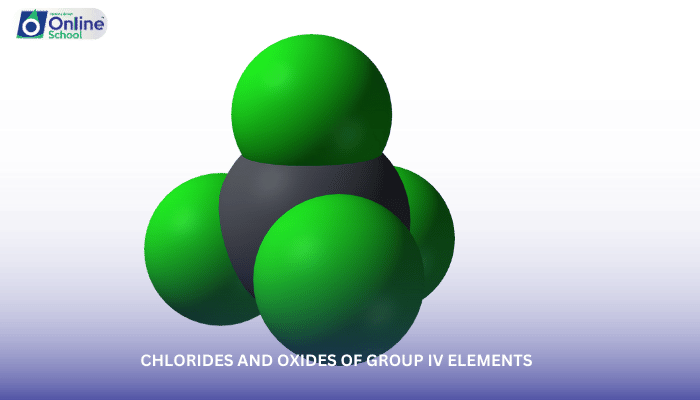
Carbon tetrachloride (CCl4): A colorless liquid, nonpolar, and chemically inert.
Silicon tetrachloride (SiCl4): A colorless liquid, highly reactive, and forms silicones upon hydrolysis.
Germanium tetrachloride (GeCl4): A colorless liquid, highly reactive, and used in semiconductor production.
Tin tetrachloride (SnCl4): A colorless liquid, fumes in moist air, and used as a catalyst in organic synthesis.
Lead tetrachloride (PbCl4): A yellow solid, highly reactive, and a powerful oxidizing agent.
iii. Oxides of Group IV Elements:
Structural Differences:
The oxides of Group IV elements exhibit distinct structural differences due to the varying electronegativity of the elements.
Carbon dioxide (CO2): A linear molecule with sp hybridization of carbon.
Silicon dioxide (SiO2): A giant covalent network solid with SiO4 tetrahedra linked through oxygen atoms.
Germanium dioxide (GeO2): A network solid with a distorted rutile structure.
Tin dioxide (SnO2): A tetragonal or orthorhombic structure with SnO6 octahedra linked through shared edges or corners.
Lead dioxide (PbO2): A layered structure with PbO6 octahedra linked through oxygen atoms.
iv. Applications:
The chlorides and oxides of Group IV elements have a wide range of applications in various fields:
Carbon tetrachloride: Used as a dry cleaning solvent, refrigerant, and pesticide.
Silicon tetrachloride: Used in the production of silicon, silicones, and optical fibers.
Germanium tetrachloride: Used in the production of germanium semiconductors and catalysts.
Tin tetrachloride: Used as a catalyst in organic synthesis and glass production.
Lead tetrachloride: Used as a powerful oxidizing agent in organic synthesis.
Carbon dioxide: Used in carbonated beverages, fire extinguishers, and refrigeration.
Silicon dioxide: Used in glass production, abrasives, and semiconductors.
Germanium dioxide: Used in polishing compounds and ceramics.
Tin dioxide: Used in ceramics, gas sensors, and batteries.
Lead dioxide: Used in batteries and pigments.
Chlorides and oxides of Group IV elements play a significant role in various industrial and technological applications. Understanding their preparation, properties, and applications is crucial for their effective utilization in various fields.
